These reasons, and many others, make the presidency of the United States a sought after position. Billions of dollars are spent and trillions of hours invested by thousands of people around the country. In the last five presidential elections (2000-2016) nearly twelve billion has been spent (about 2.5 billion a year)1.
In Article II, Section 1, the Constitution lays out three requirements in order to run for president. First, the candidate must be thirty five years old. Second, they must be a citizen of the United States. Finally, they must have lived in the U.S. for the last fourteen years.
To run for president potential candidates decide which political party they affiliate with. A political party is a group of people who usually support or oppose the same government policies. The two major political parties in the United States are the Democrats and the Republicans.
There are many independent parties as well, such as the Libertarian Party, the Green Party, and even the Pizza Party! Each party lands somewhere on the political spectrum.
Communism is on the far left, and fascism is on the far right. Republicans tend to lean right, supporting small government and low taxes, while Democrats tend to lean left, supporting big government and welfare programs. Other parties are scattered in various places on the spectrum.
 |
https://s31.postimg.org/z5kqlda4b/political_spectrum.png
|
Once a potential candidate has decided which party they support, they start rallying support for themselves. The most popular candidates are often asked to a debate held by the party they affiliate with. For example, in the 2016 presidential election, the top ten Republican candidates were on the first Republican debate.
The debates are only one part of preparing for the primaries. A primary is a preliminary election to select the candidates for a presidential election 2. Each party has its own primary. Other ways candidates prepare for the primaries are getting out and meeting people, trying to raise funds, and making a website to get the word out about themselves.
A key thing to notice is that primaries do not choose the candidate, they choose a delegate - an actual person - who will attend a convention. The delegate will vote for the presidential candidate at the convention.
A key thing to notice is that primaries do not choose the candidate, they choose a delegate - an actual person - who will attend a convention. The delegate will vote for the presidential candidate at the convention.
When the primaries finally do roll around, voters go to the polls and vote for which candidate they think should represent a party. Depending on the state, there are three types of primary: the closed primary, where voters registered as Democrats are only allowed to vote for Democratic candidates (and vise versa); the open primary, where voters are allowed to choose a party to vote for, but may only vote in one primary; and the blanket primary, where voters are allowed to vote in all primaries.
Some states, however, don't even have a primary. They have something called a caucus. A caucus is when members from the same political party have a meeting where debates and discussions take place 3. The caucuses choose which delegates they think will represent them best at the party's convention.
After the primaries and caucuses take place, delegates are gathered at something called a national convention to vote for the candidate the voters chose. The events are often shown on TV, and many speeches are given by various party leaders. During the convention, the delegates vote, and the party's presidential candidate is made official. It's also at the conventions that the candidate makes their choice for vice president official.
After the national conventions, each candidate begins to campaign across the country. This campaigning is very similar to the campaigning the candidates did before the primaries were held. The candidates usually tend to focus on several 'swing states.' There are states that almost always go Democrat, and states that almost always go Republican. (For example, California is a Democratic state and Texas is a Republican one.) These states are not set in stone by any means, but they are generally considered "safe states."
The general election is held on the Tuesday after the first Monday in November. Originally, states set their own voting dates, but in 1845 Congress passed a law setting the general election voting day to what it is currently. Tuesday was chosen so that farmers would have a day to travel to the place they would vote without having to skip church on Sunday.
The final part of the election is often the most confusing - the electoral college. This video from Prager University may help explain the process.
After the primaries and caucuses take place, delegates are gathered at something called a national convention to vote for the candidate the voters chose. The events are often shown on TV, and many speeches are given by various party leaders. During the convention, the delegates vote, and the party's presidential candidate is made official. It's also at the conventions that the candidate makes their choice for vice president official.
 |
| http://i2.cdn.cnn.com/cnnnext/dam/assets/160726190655-11-dnc-gallery-0726-super-169.jpg |
The general election is held on the Tuesday after the first Monday in November. Originally, states set their own voting dates, but in 1845 Congress passed a law setting the general election voting day to what it is currently. Tuesday was chosen so that farmers would have a day to travel to the place they would vote without having to skip church on Sunday.
The final part of the election is often the most confusing - the electoral college. This video from Prager University may help explain the process.
Remember, electors are actual people chosen by party leaders. Electors are usually the people who donate large amounts of money - often - to the party. They must be very loyal to their party for the party to choose them as an elector.
As mentioned in the video, December is when the electors meet to officially decide the next president. In 2016, it was December 19th. Electors are expected to vote for whomever their state voted for. This is why the media can call elections before December. Electors are are expected to vote for the same candidate their state chose. Because they are also loyal to their party, hardly ever will an elector decide to vote for the opposing candidate.
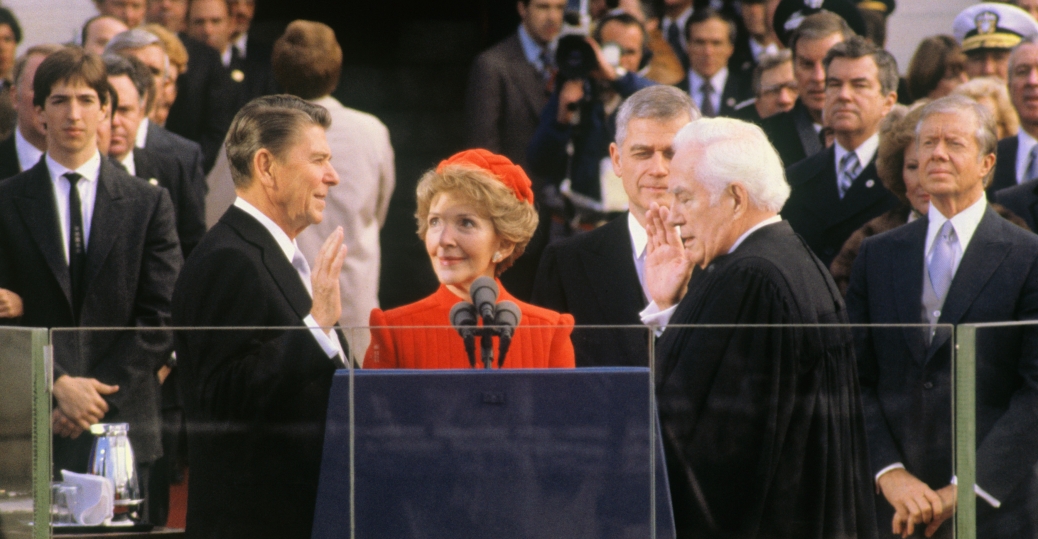
The final step before the elected candidate (now called the president-elect) is officially considered President of the United States is the inauguration. At the inauguration, the president elect puts his right hand on a Bible and says the following:
I do solemnly swear (or affirm) that I will faithfully execute the Office of President of the United States, and will to the best of my ability, preserve, protect, and defend the Constitution of the United States
President Reagan's swearing-in in 1981
 |
| http://cdn.history.com/sites/2/2013/12/reagan-swornin-P.jpeg |
The time between when the potential candidate makes their announcement that they're running for president, to when they are inaugurated can be more than twenty months. In the case of Donald Trump, the winner of the 2016 election, it will be nineteen months and four days.
From the announcement that they're running for president, through the pre-primary campaigning and debates, to the primaries and national conventions, past the post-primary campaigning and debates, to the general election and electoral college vote, all the way to the inauguration, running for president is no easy task. But that's only fair - the presidency of the United States is nothing to be trifled with.
Notes:
1. https://www.opensecrets.org/overview/cost.php?display=T&infl=Y (Amount has been adjusted to account for inflation)
2. http://www.dictionary.com/browse/primaries (see definition 15)
3. http://www.dictionary.com/browse/caucus
3. http://www.dictionary.com/browse/caucus
Other references:
https://votesmart.org/education/president#.WFxjP_ArLIU
https://www.facebook.com/The-Pizza-Party-of-the-United-States-of-America-120254701372571/
https://votesmart.org/education/presidential-primary#.WGCpEvArLIV
http://www.history.com/news/ask-history/why-do-we-vote-on-a-tuesday-in-november
https://www.archives.gov/federal-register/electoral-college/key-dates.html
https://votesmart.org/education/presidential-primary#.WGCpEvArLIV
http://www.history.com/news/ask-history/why-do-we-vote-on-a-tuesday-in-november
https://www.archives.gov/federal-register/electoral-college/key-dates.html